
Bel Air, MD · Garage Door Service
Garage Door Spring Repair for White Marsh Homes
White Marsh homes run newer than most of our territory. Here's how that changes spring repair, what it costs, and why we drive the twelve miles from Bel Air to do it.
- Repairs & new doors
- Springs & openers
- Serving 7 nearby communities
The Cost of This Job
White Marsh is twelve miles from our shop in Bel Air, and that drive is baked into how a call here runs. We're not based in White Marsh - nobody covering this suburb is - so every job starts with a truck loaded before it leaves, not a scramble to find the right spring size once we're on site. That matters because White Marsh's housing stock skews newer than most of what we see closer to home: median build year here is 1985, a good decade past the 1960s-70s stock that fills most of the 22 areas we cover. Newer doors usually mean standard torsion spring sizes that are easy to stock, which keeps this job from turning into a wait for a part. We quote the spring repair itself once we've seen the door, the spring size, and whether it's a single or double - we don't price blind over the phone. What we can tell you up front is that the twelve-mile trip doesn't get tacked on as a separate line; it's part of why we plan the day's route before the first call goes out.
How We Fix It
A broken torsion spring on a sectional door gets replaced, not patched - there's no safe partial fix for a spring that's split or has lost tension. We match the spring to the door's actual weight and drum size rather than guessing off the old one, because a mismatched spring either won't lift the door cleanly or will wear out fast. On the newer doors common to White Marsh's 1985-median housing, that's usually a straightforward swap: standard torsion hardware, steel sectional panels, nothing exotic. We check the cables and the bottom brackets while we're in there, since a spring failure sometimes takes a cable with it, and we test the door's balance with the opener disconnected before we call the job done. If the opener's been straining against a dead spring for a while, we'll flag that too - it's a separate issue, but one that shows up often enough to mention. We don't upsell a full door replacement on a spring call unless the panels or track genuinely warrant it.
Why It Happens Here
Springs fail from cycle count and from temperature stress, and White Marsh gets both. Maryland sits in a cold-severe climate band, and that doesn't care what year a house was built - a torsion spring on a 1985 door goes through the same winter contraction and summer expansion as one on a house built in 1960. What differs in White Marsh is the housing itself: a median build year of 1985 means most of these doors and their original hardware are younger than the bulk of the territory's 1957-1990 stock, so the springs we're replacing here are more often original-to-a-newer-door rather than a decades-old mismatch. With about 4,054 households in White Marsh, it's one of the smaller pockets we cover, and newer construction generally means less of the patched-together hardware we see on older stretches of the territory. That doesn't mean springs here last forever - they still run on a cycle count, and a well-used double door wears one out regardless of the build year on the house.
How It Shows Up
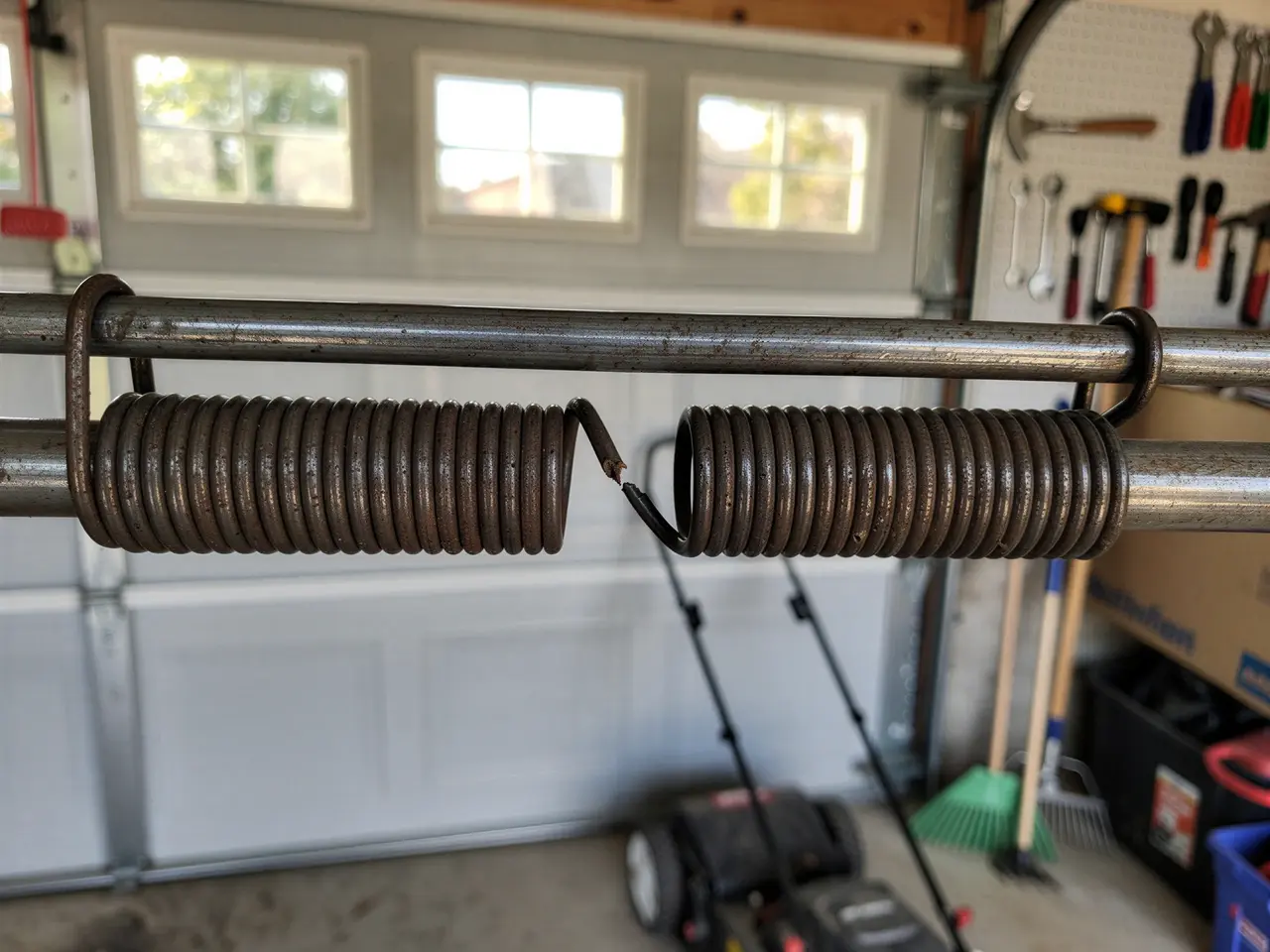
The door gets heavy fast, or it doesn't move at all. Most owners notice it when the opener strains, makes a grinding sound, or the door reverses partway up - the opener isn't broken, it's just trying to lift a dead weight it was never built to carry alone. A visible gap in the coiled spring above the door, or one half of it hanging loose, means it's already split. Some doors give a warning first: a sag on one side, a door that closes crooked, a louder-than-usual bang when it closes because the spring's lost tension gradually rather than snapping outright. White Marsh's newer housing stock means fewer of the oddball or custom door sizes we run into on older streets, so when a spring goes here, it's usually a standard fix rather than a hunt for a discontinued part. Either way, don't try to force the door open by hand once a spring's gone - that's how a cable snaps or a bracket tears loose, and that turns a spring job into a bigger one.
Where This Job Goes Sideways
The trouble starts when someone tries to loosen or wind the spring themselves. A torsion spring under tension can break a hand, an arm, or worse if the winding bars slip - this isn't a job for the homeowner's toolbox, full stop. The other way it goes sideways is less dramatic: a spring gets replaced but the cables, drums, or bottom brackets that took the same stress don't, and the new spring fails early or the door comes off-track within months. We've also seen owners order a spring online by matching the broken one's length and wire gauge without checking the door's actual weight - on a heavier double door, an undersized spring just means a repeat call. With income levels in White Marsh running well above the rest of the territory - a median household income of $123,302 against $95,975 across the wider service area - we also see more owners skip the diagnosis step and ask for the priciest part outright, assuming it's the safer bet. It usually isn't; the right spring size matters more than the price tag.
The DIY Question
Don't wind or unwind a torsion spring yourself. That's the one flat answer here - the tension involved has put people in the hospital, and there's no amount of online instruction that changes the physics of it. What you can reasonably do yourself: check whether the door is binding on the track, listen for which side of the door is making noise, and look at the spring for a visible gap before you call anyone. That tells us something useful over the phone and speeds up the visit. We won't pretend this is a job that rewards a confident amateur - unlike swapping a roller or tightening a hinge, a spring carries enough stored force that the margin for error is thin. If your door is newer, which is likely given White Marsh's 1985 median build year, the part itself is usually easy to source, so the honest move is to get it replaced properly rather than save a service call and risk an injury or a wrecked cable system.
Frequently asked questions
How much does it cost to drive out to White Marsh for a spring repair?
We don't charge extra for the twelve miles from Bel Air as a separate line item - it's factored into how we schedule the day. The price you pay is for the spring, the labor, and anything else the door needs, quoted once we've seen it, not a flat trip fee tacked on top.
Are garage door springs in White Marsh different from older parts of the territory?
Often yes. White Marsh's median build year is 1985, newer than much of the 1957-1990 housing stock we cover, so the torsion springs here tend to be standard sizes on steel sectional doors rather than the older or custom hardware we sometimes find on houses from the 1960s and 70s.
Can I replace a broken torsion spring myself?
No. A torsion spring holds enough stored tension to cause serious injury if it releases while you're winding or unwinding it. This is one job we'd tell any homeowner, regardless of experience with tools, to leave to someone who does it regularly.
Why did my spring break if my house is newer?
Age of the house isn't the main driver - cycle count and climate stress are. Maryland's cold-severe winters put the same expansion and contraction load on a spring whether the door went in during 1985 or 1965. A newer door just means the hardware is more likely to be a standard, easy-to-source size.
More garage door services in White Marsh
Book garage door service in Bel Air
Call now or request a quote - tell us what the door is doing and where you are.