
Bel Air, MD · Garage Door Service
What Actually Happens During a Bel Air Service Call
A straight look at what a Bel Air garage door service call checks, tied to the area's 1960s-70s housing stock and cold-climate hardware wear.
- Repairs & new doors
- Springs & openers
- Serving 7 nearby communities
How Local Conditions Play In
Most of the houses we get called to in this part of Harford County went up between 1957 and 1990, with the bulk of the stock dating from the 1960s and 70s. That matters because a door built on a house from that era is usually on its second or third opener and sometimes its original torsion spring, depending on whether anyone ever replaced it. We're in a cold-climate zone with real winter severity, not a mild coastal band, so steel cable and spring wire go through more expansion-contraction cycles each year than they would further south. That cycling is what fatigues a spring and pits a roller track faster than the owner expects. A service call here starts by asking how old the door assembly is relative to the house, because a 1970s-built door on original hardware and a 1970s house with a 2015 opener retrofit need two different inspections. We don't guess at age - we look at the spring winding, the track gauge, and the opener model plate, and we tell you what generation of parts you're actually running.
The Cost of This Job
We're not going to quote a number here because what the job costs depends on what's actually wrong, and on a 1960s or 70s door that can be a spring, a cable, a section, or the opener itself. What we can tell you is what drives the cost up in this area specifically: original hardware on houses from the 1977 median build year is often sized differently than what's sold off the shelf today, so a straight swap isn't always possible, and that adds labor. Households in this service area have a median income of roughly $96,000, and most owners we talk to want the job done right once rather than patched twice - that shapes the kind of parts we recommend, not the price itself. If your door was installed anytime near when the house was built, expect the estimate to include a conversation about whether the track and spring size we find is even still manufactured.
What Is Going On
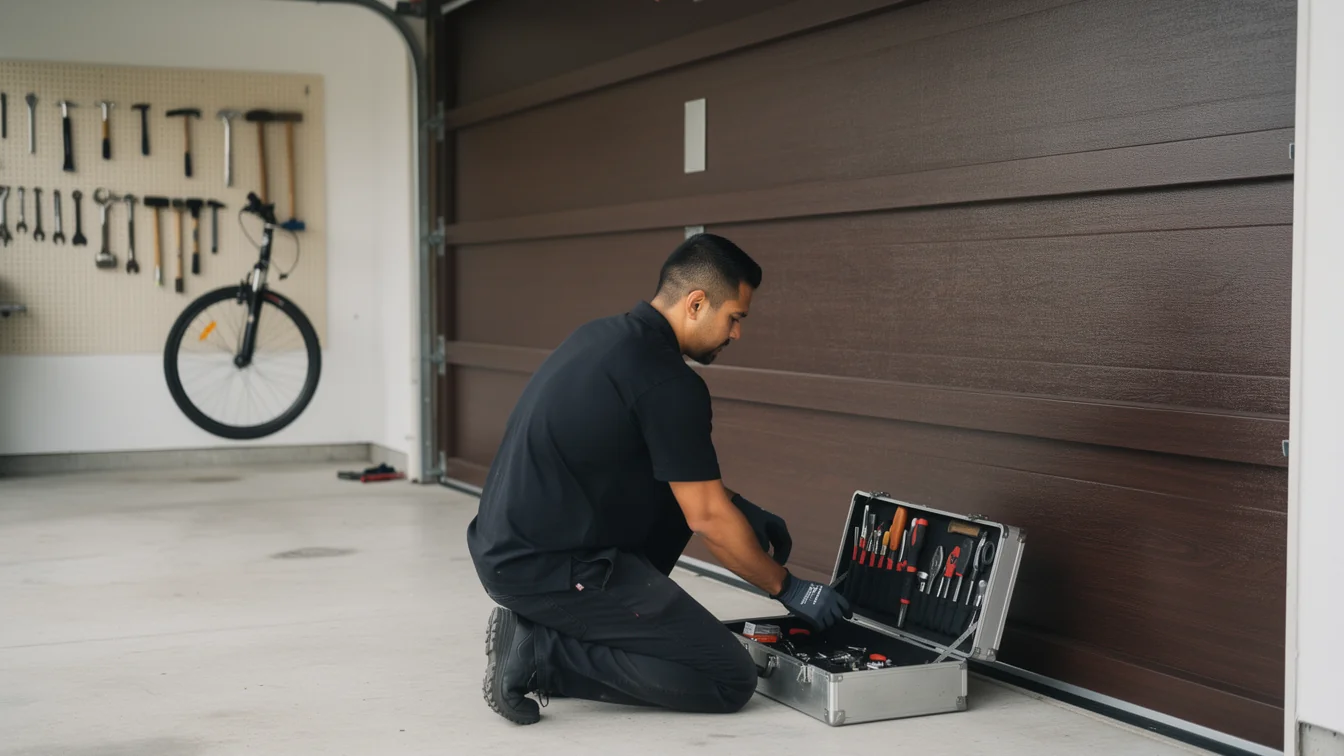
On a service call, we're diagnosing, not selling. The first thing we check is the spring - torsion or extension - because in a cold-climate zone like this one, metal fatigue from temperature swings is the single most common reason a door won't open at all. Second is the track alignment, since houses from the 1960s-70s stock across this area were mostly built with single-car or narrow double bays, and original track brackets loosen over fifty-plus years of frame settling. Third is the opener's force and limit settings, which drift on older units and cause the door to reverse or slam. We also look at the bottom seal and weatherstripping, because in this climate a cracked seal lets in enough cold air to make an opener's gears work harder in winter than they should. None of this is guesswork dressed up as expertise - it's a checklist built around what fails on houses this age, in this weather, and we walk you through what we found before we touch a wrench.
Leaving It Alone
Here's the honest part: not every noisy door needs a same-day fix. If your door is slow, a little noisy, but closes flat and reverses properly when it hits something, you can often wait and schedule rather than treat it as an emergency - that's one of the first things we tell people on the phone. Where we don't recommend waiting is a door that's stuck halfway, a spring that's visibly separated, or cables that are frayed, because those are the failures that hurt someone. One real limitation: if your door uses an original 1960s or 70s track or spring size that's been discontinued, we may need to order a part rather than carry it on the truck, and that can push a same-day job to a few days out. We'd rather tell you that up front than promise a fix we can't deliver that day.
Frequently asked questions
Do you serve areas outside Bel Air itself?
Yes. We get calls from Pleasant Hills, Fallston, Kingsville, Joppatowne, Edgewood, Perry Hall, and the wider Harford and Baltimore County area within about a twenty-mile radius, including Towson and Cockeysville.
Why does my spring keep breaking when the house is only from the 1970s?
A 1970s torsion spring has gone through close to fifty winters of expansion and contraction in a cold-climate zone like this one. Metal fatigue is cumulative - it's not that the spring was bad, it's that it's done the number of cycles it was rated for.
Can you match the original track size on an older house?
Sometimes. Houses built in the 1960s-70s era around here often used track and spring dimensions that aren't standard stock today. We check the measurements on-site and tell you honestly whether it's a straight match or a full-track upgrade.
Is a service call just an inspection, or do you fix things the same visit?
Most of what we find - spring adjustment, track alignment, opener force settings, weatherstrip replacement - we handle the same visit. If a part needs ordering, which happens more often on older original hardware, we'll tell you before we leave.
Related garage door services in Bel Air
More garage door guides
Book garage door service in Bel Air
Call now or request a quote - tell us what the door is doing and where you are.