Bel Air, MD · Garage Door Service
Is Your Bel Air Garage Door Worth Fixing, or Done For
Bel Air homes mostly date 1957-1990, and the cold winters here are hard on original hardware. Here's how to tell if your door's worth fixing or replacing.
- Repairs & new doors
- Springs & openers
- Serving 7 nearby communities
How Local Conditions Play In
Most of the houses in this part of Harford County went up between 1957 and 1990, with the median build year sitting around 1977. That matters for one simple reason: a door that age was likely installed with the house, and it's carrying 40-plus-year-old steel, hinges, and in a lot of cases the original torsion hardware. We work across 22 named areas near Bel Air, from Pleasant Hills and Fallston out to Kingsville and Joppatowne, and the pattern holds in most of them - 1960s and 70s stock dominates the neighborhoods we get called to.
On top of the age, this is a cold-climate region with severe winter swings. That combination - old steel and hard freeze-thaw cycles - is what actually breaks doors here, not just time passing. Panels on a 1970s door were never built with today's insulation standards in mind, so the steel flexes more in a hard freeze, and seams that were fine in July start letting daylight through by January. A door that's merely old but well-sealed can last. A door that's old and already gapping at the bottom panel is the one that's going to give you trouble every cold snap from here on.
The Cost of This Job
We can't quote a number without seeing the door, so I won't pretend otherwise here. What I can tell you is what drives the cost up on a house from this era: original hardware. If your door still has its factory torsion spring and drum setup from the 1960s or 70s, parts for it are often discontinued, which means a repair isn't a quick swap - it's a full hardware upgrade dressed up as a repair. That tends to close the price gap between fixing and replacing faster than people expect.
Household income in this service area runs well above the national median, and we see that reflected in how people decide - a lot of owners here choose to replace rather than nurse along a door that's fighting them every winter. That's a reasonable call on a 40-year-old door with worn rollers and a strained opener, but it's not the only right answer. A door with good bones and one bad spring is still cheaper to fix than replace, regardless of its age.
What Is Going On
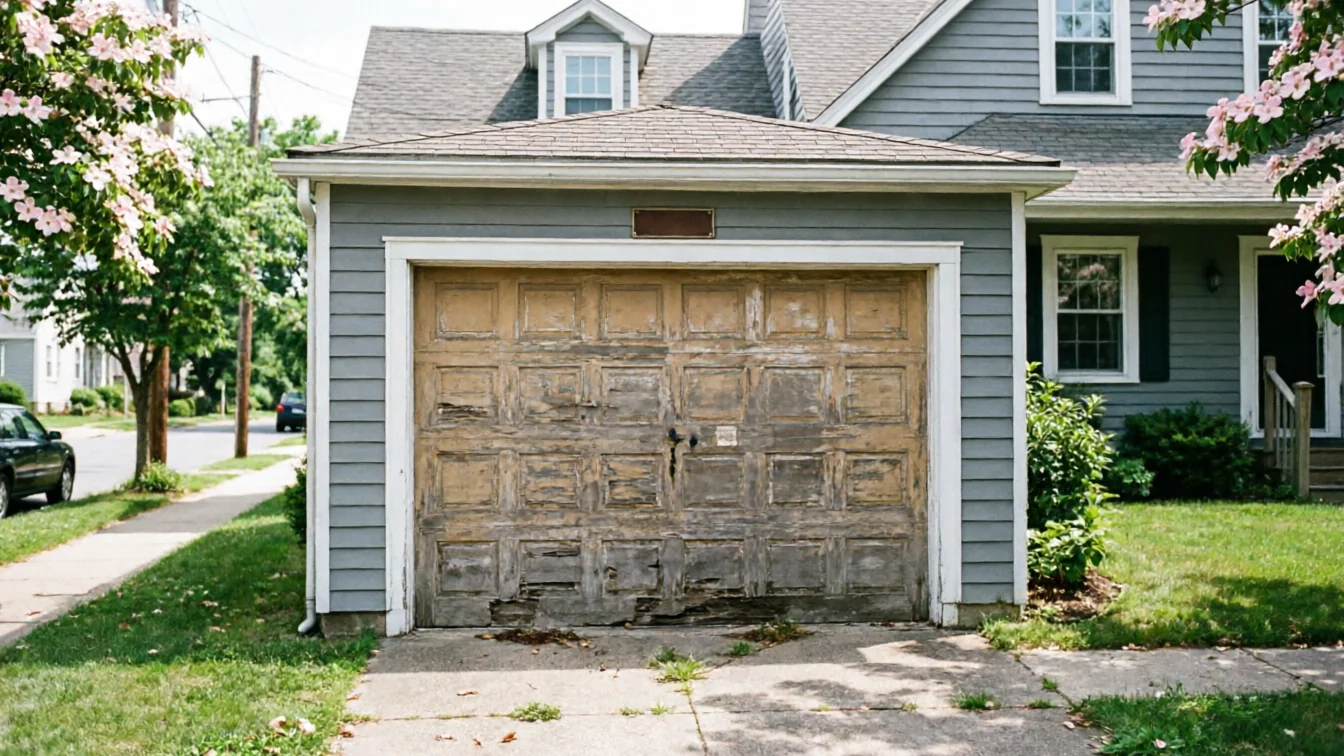
When a call comes in from a house built in this stretch of years, the story is usually one of three things. First: a torsion spring that's simply worn out from age and cold-weather cycling - springs have a lifetime measured in cycles, and decades of winter use eats through that count faster than a mild climate would. Second: original rollers and hinges that have gone stiff and noisy, often paired with a track that's slightly out of alignment from years of frost heave under the slab. Third, and the one that tells you the door itself is failing, not just its parts: steel panels that have started to separate at the seams or show rust along the bottom where snowmelt sat against them.
The first two are repairs. The third is a replacement conversation, because once the panel steel itself is compromised, no amount of new hardware fixes the underlying problem. The door we're looking at is doing exactly what a 40-to-60-year-old door in a cold climate does - it's not failing from neglect, it's failing from math.
Leaving It Alone
Here's the honest limitation: if your door is original to a house built in the 1960s or 70s and it's still operating smoothly, we're not going to talk you into replacing it just because of its age. Plenty of doors from that era, especially single-panel or two-panel steel doors with simple hardware, keep working fine for years with basic spring and roller maintenance. Age alone isn't the problem.
But ignoring a door that's already showing the signs - bottom panel separation, a spring that's lost tension, a track pulling away from the jamb after a hard freeze - costs you more the longer you wait. In this climate, a door that's struggling in November is usually failing outright by February, and a stuck door in a severe cold snap isn't just inconvenient, it's a door you can't close against the weather. If yours is still quiet and square, leave it alone. If it's already fighting you, don't wait for the next freeze to find out how bad it'll get.
Frequently asked questions
My house was built in the 1970s - is my garage door original?
It's possible. Most homes in this part of the service area went up between 1957 and 1990, median around 1977, and a lot of them still have their original door and torsion hardware. If you've never replaced it, check the spring and hardware date - original setups from that era are the ones most likely to be running on discontinued parts.
Why does my old door get worse every winter?
This is a cold climate with severe swings, and steel panels and springs from decades-old doors weren't built for today's insulation standards. Freeze-thaw cycling adds stress every season. A door that was marginal in fall often fails outright by the coldest part of winter, which is why the same old doors keep coming up on our calls.
Is it worth fixing a 40-year-old garage door?
If the panels are solid and it's one bad spring or a set of worn rollers, yes - that's a straightforward repair regardless of age. If the steel itself is separating at the seams or rusted through, you're better off replacing it, because new hardware on failing panels doesn't hold up.
Related garage door services in Bel Air
More garage door guides
Book garage door service in Bel Air
Call now or request a quote - tell us what the door is doing and where you are.