Bel Air, MD · Garage Door Service
Garage Door Service for Bel Air's 1960s-70s Housing Stock
Garage door repair and tune-up service for Bel Air homes built 1957-1990, where original torsion hardware and cold-weather wear cause most of the calls we run.
- Repairs & new doors
- Springs & openers
- Serving 7 nearby communities
The Cost of This Job
We don't quote a flat number for garage door service over the phone, and we won't pretend to here, because what a job costs depends on what's actually wrong once we're looking at the door and track in person. A worn roller on a 1980s steel door is a different job than a torsion spring that's seized from age on a house built when this area was first being developed in the late 1950s through the 1970s. What we can tell you is that most of the service calls we run in Bel Air involve original hardware that's now 40 to 60 years old, and parts that age cost more in labor than in material - the spring itself is cheap, getting at a track that was installed before modern mounting standards is where the time goes. If a shop quotes you a number before seeing the door, be skeptical of it. We'd rather look first and tell you straight whether a repair makes sense or whether you're better off replacing the unit, especially on a door old enough that its parts are no longer a standard stock item anywhere.
Parts We Carry
Because Bel Air's housing mostly dates to 1957-1990, with the bulk of it from the 1960s and 70s, we stock the torsion springs, extension spring cable, and roller sizes that fit doors from that era, not just whatever ships fastest from a big-box supplier. A lot of that housing stock still runs side-mounted torsion hardware or older extension-spring setups that newer doors don't use at all, and those parts don't sit on the shelf at a typical hardware store. We also carry weatherstripping and bottom seals sized for cold-climate gaps, which matters here since this area sits in a severe cold climate band and a loose or cracked seal means heat loss and ice buildup at the threshold every winter. What we don't stock is custom-order panel sets for doors that have been discontinued for decades - if your door needs a replacement panel that no longer exists, we'll tell you that's a replacement job, not a repair, rather than stringing out a part order that may never come.
Why It Happens Here
A severe cold climate does specific things to a garage door that a mild one doesn't: steel contracts and expands with every freeze-thaw cycle, torsion springs lose tension faster in sustained cold, and lubricant that's fine in July turns thick enough to drag a roller through its track in January. Combine that with a housing stock built mostly between 1957 and 1990 - median year 1977 - and you get doors and openers that were installed under a completely different set of expectations about insulation and hardware tolerance than what's sold today. Across the 22 named communities we cover, most of what we see is original or first-replacement hardware from that same build window, meaning springs, cables, and track brackets that have taken 40-plus winters of that contraction cycle. None of this is dramatic on its own, but it adds up: a track bracket that's loosened a quarter-inch over decades doesn't fail in summer, it fails on the first hard freeze when steel pulls tight against a bolt that's already worked loose.
How It Shows Up
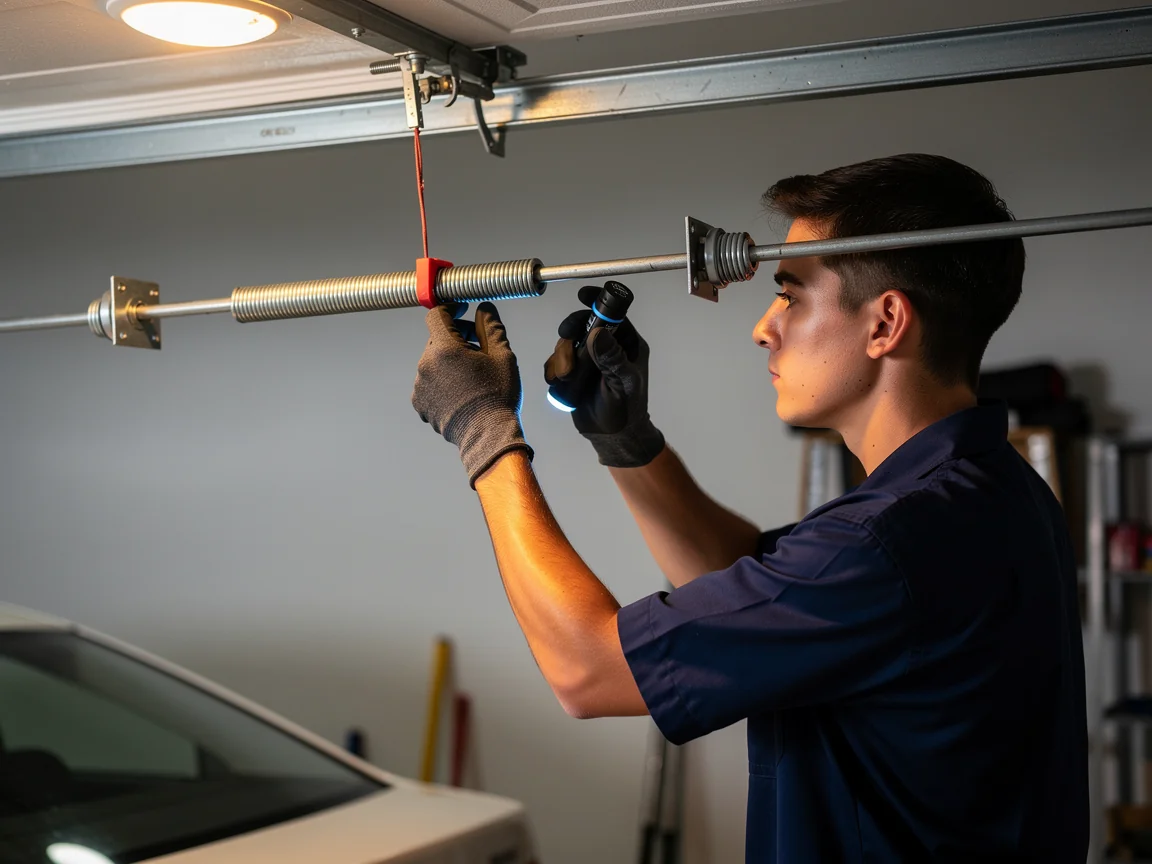
The most common call we get isn't a door that won't open at all - it's a door that's gotten noisy or slow over a season, which is usually the cold doing its work on aging hardware before something actually breaks. You'll hear it in a grinding or popping sound from the spring as it loses tension, or feel it in an opener that strains and stalls partway up on a cold morning. On older doors from the 1960s-70s stock that makes up most of this area's garages, a sagging panel at the bottom corner is often a cable that's started to fray against a track edge that's shifted slightly out of plumb over the decades. If you own a house in one of this area's older sections and the door's started sticking only on the coldest days, that's not a coincidence - it's the spring telling you it's near the end of what cold cycling and 40-plus years of service can ask of it.
Frequently asked questions
Why does my garage door only act up in winter?
Cold steel contracts, and torsion springs lose tension faster in sustained cold, so slack that's invisible in summer shows up as grinding, slow travel, or a stalled opener once temperatures drop. This area sits in a severe cold climate band, so that cycle repeats every winter on older hardware.
My house was built in the 1960s - is that why parts are hard to find?
Likely yes. Most of this area's housing dates to 1957-1990, with a lot of it from the 1960s and 70s, which means original torsion or extension-spring setups that newer doors don't use. We stock sizes for that era, but some older panel sets are genuinely discontinued.
Can you give me a price before you come out?
Not honestly. What a repair costs depends on what we find once we're looking at the spring, track, and opener in person - a worn roller and a seized decades-old torsion spring are not the same job, even on the same style of door.
Related services
Related guides
By Neighborhood
Garage Door Service across the Bel Air area
We also handle garage door service in these Bel Air-area suburbs.
Book garage door service in Bel Air
Call now or request a quote - tell us what the door is doing and where you are.