Bel Air, MD · Garage Door Service
Garage Door Installation for Bel Air's 1960s-80s Housing Stock
Bel Air homes built from 1957-1990 are hitting the age where original doors and openers give out. We install replacement doors built for Harford County winters.
- Repairs & new doors
- Springs & openers
- Serving 7 nearby communities
The Cost of This Job
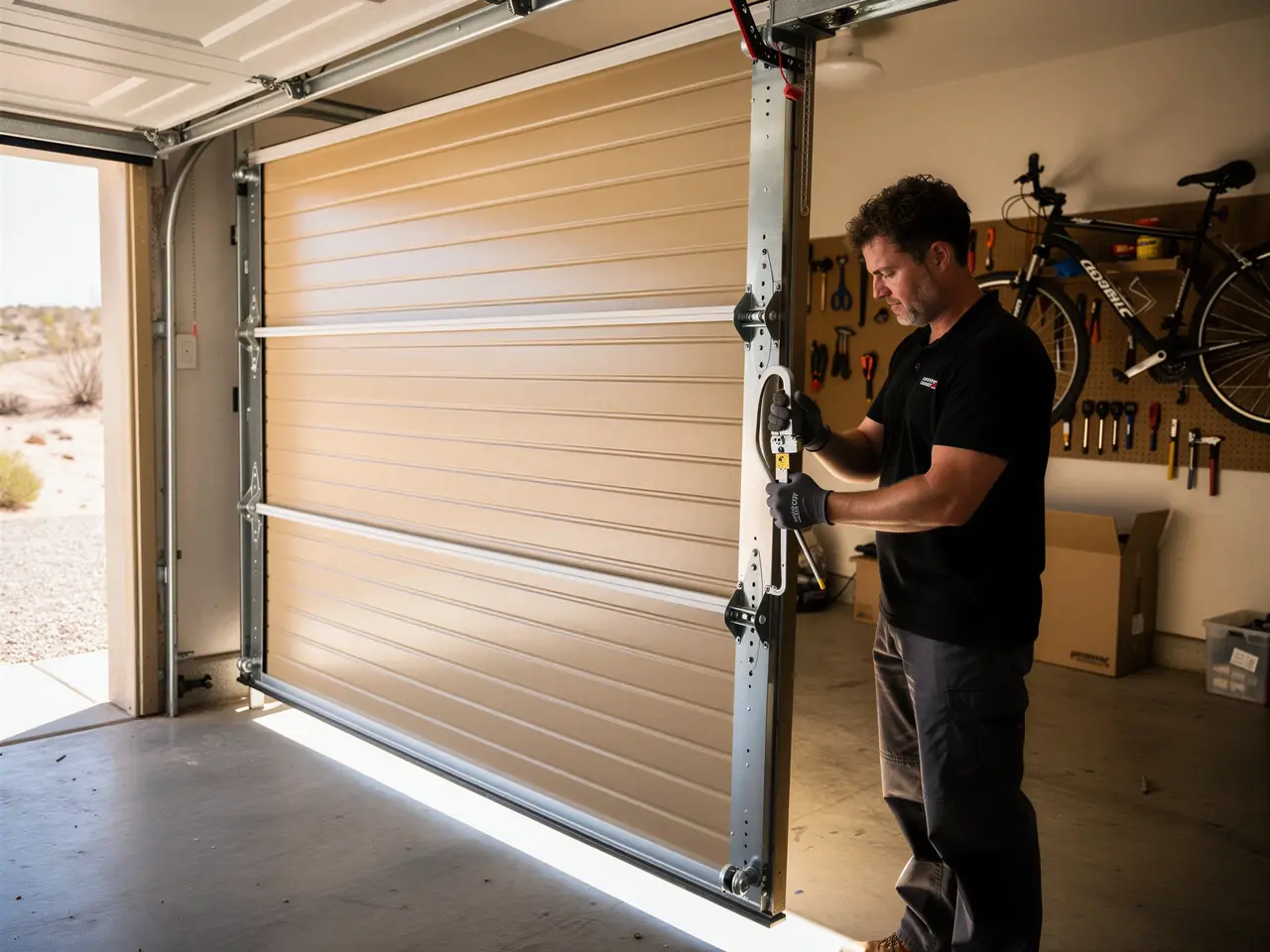
We don't post a flat number here because installation cost in Bel Air depends on what's actually on the house. A single-car door on a home built in the 1960s with original wood jambs is a different job than a double-wide door on a 1980s build with aluminum trim already rotted at the base. What drives the price on most calls we run: door size, insulation level you want (worth asking for, given how cold it gets here), whether the opener gets replaced at the same time, and whether we're fighting old framing that needs reinforcement before a new door can even go in square.
Households in this service area have a median income around $95,975, and we see people make two different calls with that budget - some want the cheapest code-compliant door in, others want an insulated steel door that'll outlast the house's next owner. Both are reasonable. What's not reasonable is quoting you a number before we've looked at your jambs, your header, and your opener mounting. If someone quotes a firm price over the phone sight unseen, ask what they're skipping.
One honest limit: we don't install on tracks or framing that's structurally failed. If your header is sagging or your jamb is rotted through, that gets fixed or replaced first - it's a separate line item, not something we fold into the door price to make a lower number look good.
Parts We Carry
Housing in Bel Air's 22 named service areas mostly dates to the 1960s and 70s, with the broader range running 1957 to 1990 and a median build year of 1977. That means a lot of homes still running original torsion hardware sized for lighter, uninsulated single-layer doors - steel shells with no thermal break, the kind that were standard before insulated doors became common. We stock insulated steel sections sized to match the openings built during that era, along with torsion springs rated for the heavier insulated panels, since swapping a light door for a heavier one without upgrading the spring just means a new door with the wrong spring.
We also carry weather seal kits sized for the gap tolerances common on framing from that build period - older jambs settle differently than new construction, and a stock seal often doesn't close right without trimming. For homes that have already had one replacement door installed (common once a house hits 40-plus years), we carry universal track and roller kits that fit most previous-generation openings without requiring a full frame rebuild.
What we don't stock on the truck: oversized custom doors outside standard width and height, and decorative wood doors - those get special-ordered and the lead time is the manufacturer's, not ours.
Why It Happens Here
Bel Air sits in a cold-climate band with severe winter conditions, and that matters more for installation decisions than most homeowners expect. A door that's merely adequate in a mild climate is undersized here - uninsulated steel flexes and bows in a hard freeze, and the gap between door and frame opens up enough to let wind through, which is exactly what the original doors on 1960s and 70s-era homes were built without accounting for.
The other driver is simply age distribution. With most of the housing stock here dating to 1957-1990, a large share of doors in this service area are either original or on their first replacement, and both groups are now old enough that openers, springs, and tracks are wearing out at roughly the same time across whole streets. That's not a coincidence - it's a housing stock built in a tight few decades, aging in sync.
We size every new install to the cold-climate standard rather than a national baseline - thicker insulation, better seal at the floor, and hardware rated for the temperature swings a Harford County winter actually produces, not a mild-winter average.
How It Shows Up
The call usually starts with one of two things: a door that's gotten noticeably harder to lift by hand, or an opener that's started straining and groaning partway through the cycle. On original doors from the 1960s-70s era, that's often a door that was never insulated catching up to itself - the steel has fatigued, the seams have loosened, and the weight distribution the opener was calibrated for 40 years ago isn't the weight it's lifting now.
On homes that already went through one replacement, we see openers that were sized for an older, lighter door now fighting a heavier insulated panel that's slowly sagged out of square. The symptom looks electrical - opener cutting out, remote losing range - but the root cause is a door that's no longer square in its track, which an opener can't fix no matter how many times you replace it.
Cold makes both worse. A door that's borderline in October will bind, stick, or refuse to seat in January, when steel contracts and old weather strip has already given up. If your door's gotten hard to lift by hand before the opener even complained, that's the window to call, not after it stops working altogether.
Frequently asked questions
Will a new door fit my original 1960s or 70s opening without rebuilding the frame?
Usually, yes. Most homes in this service area built between 1957 and 1990 have openings sized to a handful of standard widths, and we stock sections to match. Framing only needs rebuilding if the jamb or header has rotted or settled out of square - common on older homes, but not universal.
Do I need an insulated door given how cold it gets here?
It's not required by code, but given the severe cold-climate conditions in this area, an uninsulated door will flex, bind, and let more cold air into an attached garage than an insulated one. If the garage shares a wall with living space, insulation pays for itself faster than most people expect.
How do I know if I need a new door or just a new opener?
If the door is hard to lift by hand with the opener disconnected, the problem is the door, spring, or track - not the opener. Replacing the opener on a door that's binding just gives you a stronger motor fighting the same bad geometry.
Can you match the look of my current door if I'm only replacing it because it's worn out, not broken?
We can often get close with standard steel panel styles, but exact matches aren't guaranteed, especially on older homes where the original door style may no longer be in production. We'll show you what's available before you commit.
Book garage door service in Bel Air
Call now or request a quote - tell us what the door is doing and where you are.