
Bel Air, MD · Garage Door Service
Garage Door Maintenance for White Marsh's 1980s-Era Doors
White Marsh's doors are mostly 1980s steel sectional units, not the older single-bay doors common closer to Bel Air. Here's what upkeep actually looks like on this stock.
- Repairs & new doors
- Springs & openers
- Serving 7 nearby communities
The Cost of This Job
A maintenance visit here isn't priced off a landmark or a zip code story - it's priced off what we find on the door. Most doors in White Marsh went in during the building push of the 1980s, with a local median construction year of 1985, well after the 1977 median across the wider service area. That means you're mostly looking at galvanized steel sectional doors on extension or torsion springs, sized for two-car garages, not the narrower single-bay wood doors that show up on streets built before 1960 closer to Bel Air. A tune-up on that kind of door - lube, hardware check, balance test, weatherstrip inspection - runs different money than resetting cables on a forty-year-older torsion setup with hardware nobody stocks anymore. We quote the job once we see the door, not off the neighborhood.
What we can tell you without seeing it: households in White Marsh carry a median income of $123,302, well above the $95,975 median across the rest of the service area, and that tends to track with more homeowners who maintain on a schedule rather than waiting for a failure. Fewer emergency calls, more planned visits - which is the cheaper way to own a door either way.
How We Fix It
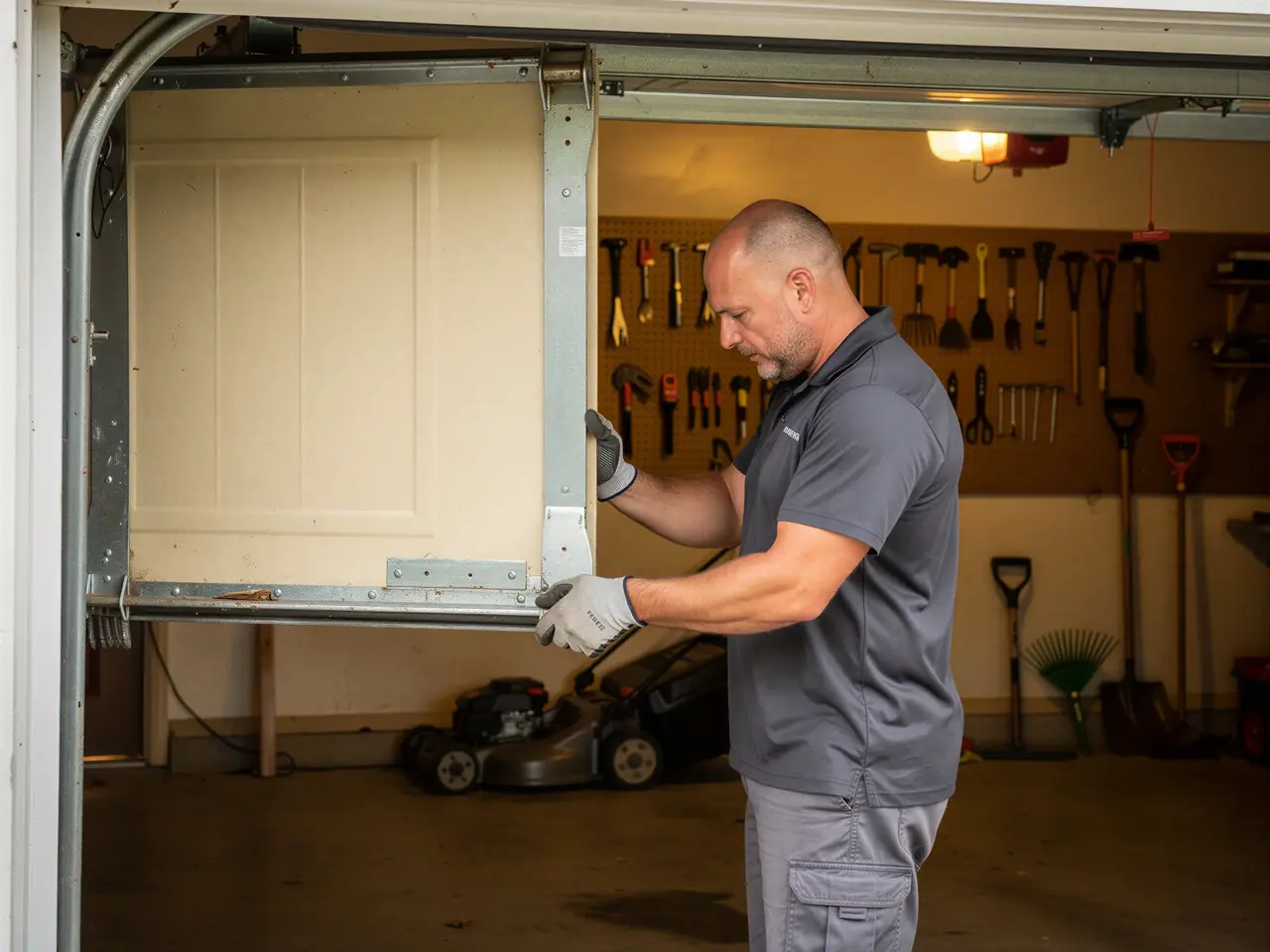
On an '80s-built steel sectional door, maintenance is mechanical, not cosmetic. We pull the rollers and check for wear grooves, test spring tension against the door's actual weight (steel sectional doors from this era run heavier than the wood doors built a generation earlier), and check the torsion bar for rust at the end bearings - a common spot on doors now pushing forty years old. We re-lubricate hinges and track with the right grade of lubricant for the season, tighten the lag bolts that back out over a few decades of cycling, and test the opener's force settings so the door doesn't slam or stall.
We also check the bottom seal and weatherstripping, which on a cold-climate build matters more than people think - a torn seal lets in more than drafts. None of this is a rebuild. It's the set of checks that keep a 1980s door running another decade instead of forcing a replacement call.
Why It Happens Here
White Marsh's housing stock clusters in that 1980s window because the area built out later than the older towns closer to Bel Air. That matters for maintenance because doors from this era used different hardware than the doors that went in during the 1960s and '70s across the rest of the service area - heavier galvanized panels, different spring sizing, factory openers rather than retrofits. The doors are newer, but they're not new. Forty years of Maryland winters, in a climate zone federal data classifies as cold and severe, means repeated freeze-thaw cycling on steel panels and on any exposed hardware. Springs lose tension gradually under that kind of cycling even when nothing visibly breaks, and a door that was balanced correctly in 1986 can be thirty percent off by now without ever throwing an obvious symptom. That's the case for a scheduled check rather than waiting for a cable to snap.
How It Shows Up
On this housing stock, the early signs are usually mechanical, not dramatic. A door that used to lift with one smooth motion starts hesitating a third of the way up - that's spring tension easing off, not the opener weakening. Rollers that were nylon from the factory start sounding gritty before they visibly wear, especially on tracks that haven't been lubricated since the house changed hands. You'll also see it in the weatherstrip: a bottom seal from the 1980s that's gone stiff and cracked lets cold air and water track in under the door, which shows up as a damp line on the garage floor before anyone connects it to the door itself.
On two-car steel sectional doors specifically, an unevenly worn cable or a slightly bent track often shows up first as a door that closes crooked by an inch or two - small enough to ignore for months, but it's the kind of wear that turns into a stuck or off-track door eventually.
Where This Job Goes Sideways
The job goes sideways when a homeowner treats a maintenance visit as a chance to also diagnose something that's already failed. A torsion spring that's visibly separated, or a cable that's frayed through, isn't a maintenance item - it's a repair, and running the door to test it is how people get hurt. We'll flag that distinction before we touch anything.
It also goes sideways on openers. A 1980s door often has an opener that's been replaced once already, sometimes mismatched to the door's current weight after parts swaps over the years. Tuning a door to an opener that's fighting it the whole time just masks the real issue, so we check that pairing before doing fine adjustments.
One honest limit: we travel from Bel Air to White Marsh, roughly 12 miles out, and we don't carry every part for every door era on the truck. If your door needs a part specific to a less common 1980s hardware setup, that can mean a short wait on parts rather than a same-visit fix.
The DIY Question
Some of this you can do yourself. Wiping down tracks, checking that the bottom seal isn't torn, and listening for new grinding or popping sounds are all things a homeowner can catch between professional visits. Lubricating hinges and rollers with the right product, a few times a year, is reasonable DIY work on a door this age.
What you shouldn't touch is the spring system. A torsion spring on a two-car steel door built in this era is under enough tension to cause serious injury if it's adjusted or released wrong, and there's no safe way to learn that by trial. Same goes for the cables and the bottom brackets they attach to. If you're not sure whether something is a lubrication job or a tension job, that's the line where a call is worth it - not because the fix is hard, but because getting it wrong on a loaded spring isn't a mistake you get to walk away from.
Frequently asked questions
How old are most garage doors in White Marsh?
Housing here has a median construction year of 1985, newer than much of the rest of the service area, so most original doors are galvanized steel sectional units from the 1980s rather than the older wood doors common on streets built before 1960 closer to Bel Air.
Do you have a branch in White Marsh?
No. We're based in Bel Air and travel to White Marsh, about 12 miles out, for maintenance and repair calls. There's no local depot here, so scheduling runs through our Bel Air office.
How often should a door from the 1980s get maintenance?
Once a year is reasonable for a door this age in a cold-winter climate. Springs lose tension gradually from repeated freeze-thaw cycling even without a visible failure, so an annual balance check catches that before it turns into a stuck or snapped-cable call.
Can I maintain the door myself?
Cleaning tracks, checking the weatherstrip, and lubricating hinges and rollers are fine to do yourself. Don't touch the torsion spring or cables - they're under enough tension on a two-car steel door to cause real injury if handled wrong.
More garage door services in White Marsh
Book garage door service in Bel Air
Call now or request a quote - tell us what the door is doing and where you are.