
Bel Air, MD · Garage Door Service
Garage Doors Built for a Different Era, Failing the Same Way Across Bel Air
Bel Air Garage Door Pros on why doors from the 1957-1990 building wave fail differently here, what a COLD-climate winter does to them, and when to stop paying for patches.
- Repairs & new doors
- Springs & openers
- Serving 7 nearby communities
How Local Conditions Play In
Most of the housing stock around Bel Air went up between 1957 and 1990, with the median sitting around 1977. That one fact explains a lot of the service calls we run. Doors from that build wave were hung before insulation rules tightened, which means a lot of single-skin steel or wood panels with no thermal break and no vapor barrier behind them. Across the 22 named areas that make up this stretch of Harford County, the pattern repeats: a garage that was never meant to hold heat, now sitting next to a finished bonus room or a workshop someone built out themselves.
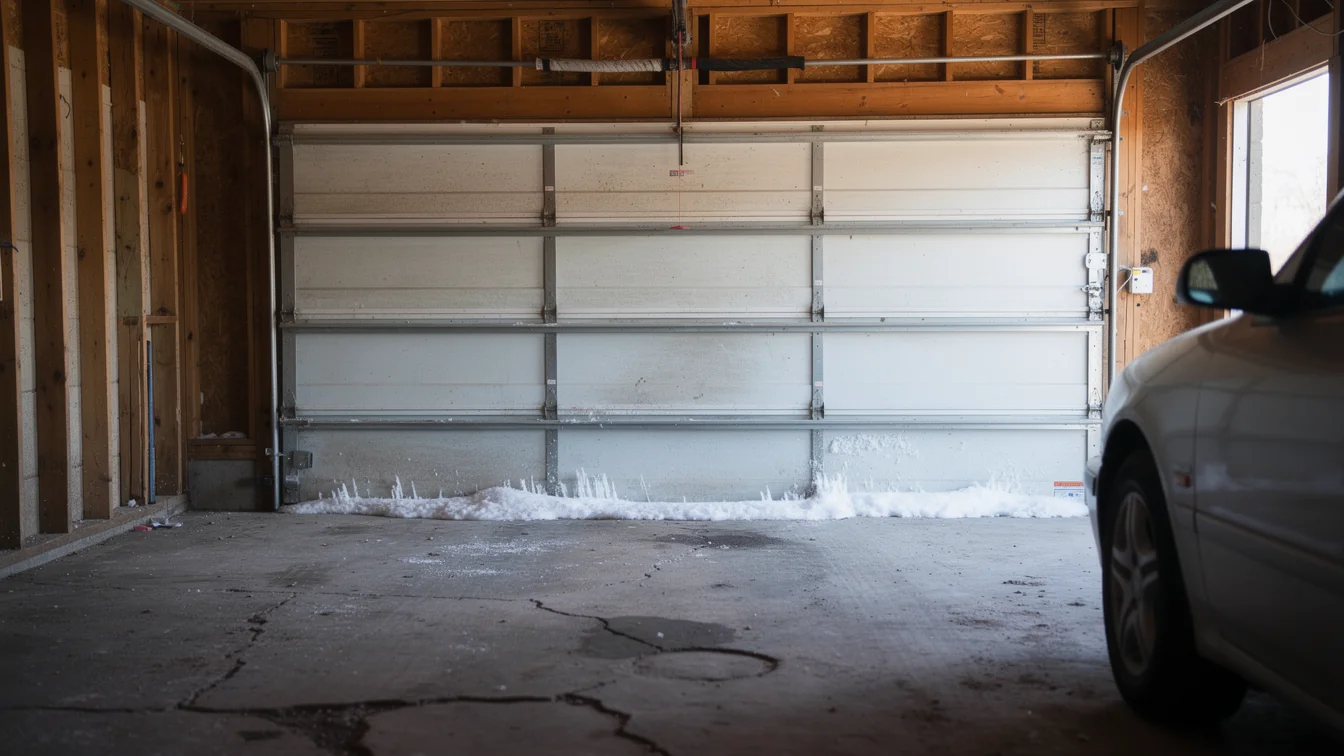
The climate band here is classified cold and severe, and that matters more on an uninsulated door than people expect. Cold doesn't just make the steel brittle - it changes how the door behaves as a system. Condensation forms on the inside face overnight, tracks rust into the bottom roller brackets faster than on a newer insulated panel, and the temperature swing between a 20-degree night and a 45-degree afternoon stresses the hinges at a rate a 1990s-built door simply wasn't engineered for. We see this on original doors from the 1960s and 70s stock more than anywhere else we go.
The Cost of This Job
We're not going to put a number on this one without a fact to back it, so here's what actually drives the bill instead. On a door from the 1957-1990 era, the panel itself is rarely the expensive part - it's what's behind it. Original hardware on houses from that stretch is often sized differently than what's stocked on the truck today, so a repair that would be a quick swap on a newer door can mean sourcing a part that doesn't come off the shelf.
With median household income in the service area sitting at $95,975 and roughly 53,088 owner-occupied houses across 158,666 households, we see a wide mix of what people are willing to spend and what the house actually needs. A lot of owners in older homes end up choosing full replacement over repeated patch jobs, not because the patch is wrong, but because an uninsulated 1970s door in a cold-rated climate keeps costing money every winter it stays in service. That's a judgment call we walk through on site, not one we make over the phone.
What Is Going On
When a call comes in from one of the areas near Bel Air - Pleasant Hills, Fallston, Kingsville, places out toward Joppatowne or Edgewood - the symptoms usually point back to the same root cause: a door built before current insulation and sealing standards, now fighting a cold climate it wasn't designed for. Springs lose tension faster in the cold, and on an original door from the 1960s-70s stock, that spring is often original too, which means it's been cycling for decades longer than it should.
We also see bottom seals that have hardened and cracked, letting cold air straight into the garage, and tracks that have gone slightly out of square as the house itself settled over fifty-plus years. None of this is dramatic. It's just a door doing exactly what a door from that era does when the winters are this cold, year after year, with nobody replacing the parts that wear out first.
Leaving It Alone
Here's the honest part: not every door on a house built in that 1957-1990 window needs to come out. If the spring, cables, and rollers have already been swapped and the panel itself is sound, there's no reason to replace something that's working. We won't talk you into a new door because the house is old.
What we won't do is chase a worn-out original door with patch after patch once it's clear the insulation gap is costing more in comfort and energy than a repair saves. That's a limitation on our end too - we can keep an old door running for years, but we can't make a single-skin 1970s panel behave like an insulated one no matter how well we tune it. In a climate this cold, that's a real difference, not a sales pitch.
Frequently asked questions
Why does my garage door act up more in winter than it used to?
If your house was built in the 1957-1990 window, which covers most of the area around Bel Air, your door likely has no insulation or thermal break. In a cold-rated climate like this one, the steel contracts, seals harden, and spring tension drops faster than on a newer insulated door, so cold-weather failures show up earlier in the door's life.
Should I repair or replace an original door from the 1960s or 70s?
It depends on what's already been replaced. If the spring and rollers are newer, a repair usually makes sense. If the door is still original end to end, you're often paying to patch a design that was never insulated to begin with, and replacement tends to pay for itself faster in a severe cold climate.
Do you work in the areas around Bel Air, not just in town?
Yes, we take calls from the surrounding areas including Pleasant Hills, Fallston, Kingsville, Joppatowne, and Edgewood, among others nearby. The housing stock and climate conditions are similar enough across that stretch that the same issues show up repeatedly.
Related garage door services in Bel Air
More garage door guides
Book garage door service in Bel Air
Call now or request a quote - tell us what the door is doing and where you are.