
Bel Air, MD · Garage Door Service
Garage Door Service for White Marsh Homes
White Marsh homes mostly date to the mid-1980s, newer than most of the service area. See what that means for your door, your spring, and the repair-or-replace call.
- Repairs & new doors
- Springs & openers
- Serving 7 nearby communities
The Cost of This Job
White Marsh runs higher income than the rest of our service area - median household income here is $123,302, well above the $95,975 median across the territory we cover. That number changes the repair-or-replace conversation. In older, lower-income pockets we cover, a cracked panel or a worn torsion spring on a door that's already near the end of its life often gets patched because replacement is a stretch. In White Marsh, homeowners are more often willing to pay once for a new opener or a full door swap rather than nurse an old unit along, especially once a repair bill starts closing in on half of what a new door costs.
That doesn't mean every call here ends in replacement. A snapped cable or a bent roller on a door built in the mid-1980s is still a straightforward repair, and we price it the same way we would anywhere - by the part, not by the zip code. What changes is how often the homeowner asks for the upgrade option alongside the repair quote. We'll give you both numbers and let you decide; we're not going to talk you into a new door you don't need, and we're not going to talk you out of one you do.
How We Fix It
We come out from Bel Air, about 12 miles south, so we bring the truck stocked for what White Marsh actually needs rather than what the oldest parts of the territory need. Houses here were mostly built around 1985, which means standard steel sectional doors on torsion spring systems - not the older extension-spring setups or one-off wood doors you find in housing stock from the 1960s and 70s elsewhere in our coverage area.
That matters for parts. A torsion spring job on an '80s-built door is a known quantity: standard drum sizes, standard shaft lengths, hardware that's still made. We carry that stock on the truck. We check the spring cycle count against the door weight, swap the spring to match, and test the balance before we leave - a door that's off by even a pound or two at the top of the track will chew through openers and cables faster than it should.
For openers, most of what we see on houses this age has already been through one replacement cycle, so we're often swapping a dead unit for a current chain or belt drive rather than retrofitting something unusual.
Why It Happens Here
The housing stock in White Marsh skews newer than most of what we cover - median year built around 1985, compared to a service-area median closer to 1977 and plenty of neighborhoods built in the 1960s and 70s. That gap means the failure patterns are different. You're less likely to see the original door from the house's construction still hanging, and more likely to see a second-generation opener or a door that's been replaced once already and is now hitting the 25-to-35-year mark where springs, rollers, and cables wear out together.
The region sits in a cold-climate band with real winter severity, and that's constant whether a house was built in 1965 or 1985 - cold steel contracts, lubricant thickens, and springs that are already fatigued are more likely to snap on a frigid morning than a mild one. What's different in White Marsh is less that the climate hits harder and more that the hardware underneath it is a decade or two younger, so the wear pattern looks like a door reaching the end of its first or second service life rather than a 60-year-old original.
How It Shows Up
On a house built in the mid-1980s, the first sign is usually the opener struggling before the door itself fails - a motor that groans on cold mornings, a door that reverses partway up, or a remote that stops working reliably. That's consistent with openers from that era reaching the end of their run, not necessarily a structural problem with the door.
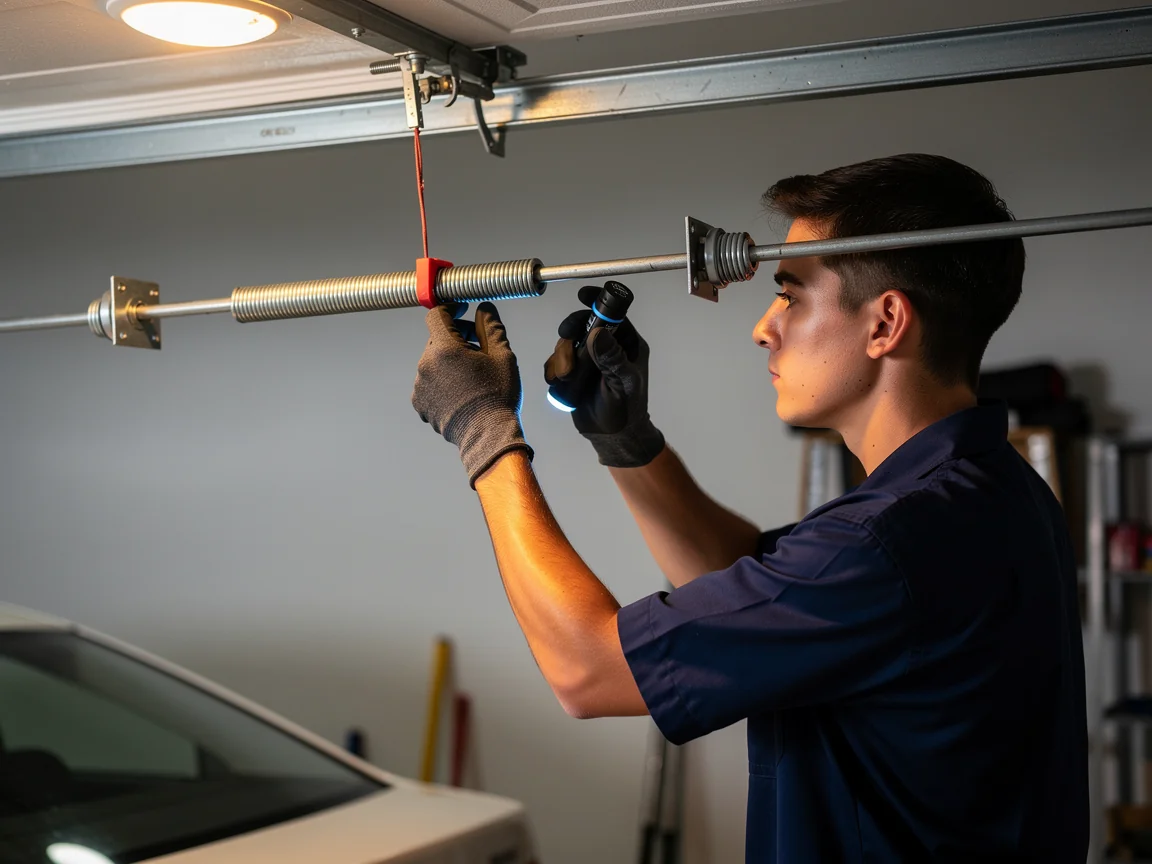
Springs on this vintage of door are almost always torsion, mounted on a single shaft above the opening, and when one goes it goes loud - a bang you can hear from inside the house, followed by a door that won't budge or that one person can't lift. Cables fraying at the bottom bracket is the other common one; you'll see a door that hangs crooked, dropping faster on one side than the other as it closes.
We don't see much of the old one-piece or tilt-up door trouble common in older housing stock elsewhere in the territory - White Marsh's doors are sectional, so the usual complaint is spring, opener, or cable, in roughly that order of frequency.
Where This Job Goes Sideways
The job gets harder when someone's tried to fix the spring or cable themselves and gotten the tension wrong before calling us. A torsion spring under partial tension is more dangerous than one that's fully wound or fully released, and we've had to spend the first fifteen minutes of a call just getting a door into a safe state before we can even diagnose it.
The other place it goes sideways is when a homeowner replaces just the opener on a door whose spring is already near the end of its cycle count. The new opener masks the problem for a few months - it's stronger, so it pushes through a door that's getting harder to lift - until the spring finally lets go anyway, sometimes under load. We'd rather check the spring first and tell you it has another year or two left than sell you an opener that papers over a bigger issue.
We're honest about the limit here too: if a door's track is bent badly enough from an impact, straightening it rarely holds for long - at that point replacing the track section is the right call, not a repeated adjustment.
The DIY Question
Given the household incomes in White Marsh, we get more calls here from people who'd rather pay for the job done right than spend a Saturday under a torsion spring, and that's a reasonable call - torsion springs store enough energy to break a bone or worse if the winding bars slip.
What is reasonable to do yourself: lubricating hinges and rollers twice a year, checking that the photo-eye sensors near the bottom of the track are aligned and clean, and tightening loose bolts on the track brackets. None of that requires touching the spring or the cables.
What isn't worth DIY-ing on a door of this age: spring replacement, cable replacement, or anything involving the torsion shaft. The parts are inexpensive, but the tools to do it safely - winding bars, a proper vise grip setup, a way to secure the door at height - aren't things most people own or want to own for a job they'll do once. If your opener is from the original installation in the mid-1980s and it's struggling, that's also a case where replacement, not repair, is usually the better math.
Frequently asked questions
How far out is White Marsh from your shop in Bel Air?
About 12 miles. We cover White Marsh as part of our regular service area out of Bel Air; there's no separate branch here, just a truck that comes out for the call.
Are White Marsh garage doors different from older parts of the area?
Mostly, yes. Housing here was built around 1985 on average, newer than much of the rest of our coverage area, which tends toward 1960s and 70s construction. That means more standard steel sectional doors on torsion springs and fewer of the older extension-spring or one-piece setups.
Does a broken spring mean I need a new door?
Not usually. A torsion spring replacement on a door from this era is a standard repair. Replacement becomes the better option when the opener, springs, and cables are all aging out around the same time, or when a repair quote starts approaching what a new door would cost.
Why did my opener die in winter?
Cold weather thickens lubricant and makes motors work harder to pull a door that's already slightly out of balance. The region sits in a cold climate band with real winter severity, and that stress tends to finish off an opener or spring that was already near the end of its life.
More garage door services in White Marsh
Book garage door service in Bel Air
Call now or request a quote - tell us what the door is doing and where you are.