
Bel Air, MD · Garage Door Service
Off-Track Door Repair for White Marsh Homes
White Marsh homes built after 1985 run newer steel-track doors than older Bel Air-area stock. See why off-track doors fail here and what fixing one costs.
- Repairs & new doors
- Springs & openers
- Serving 7 nearby communities
The Cost of This Job
We don't quote a number for this one without seeing the door first, and that's not a dodge - an off-track door can mean a track knocked an inch out of plumb by a bumped car, or it can mean a bent rail, a sheared bracket, and a cable that's walked off the drum, all at once. Those are different jobs with different parts. What we can tell you is what drives the cost: whether the track itself needs replacing or just resetting, whether rollers came out with it, and whether the spring system took any of the load when the door dropped. On a 1985-era White Marsh door, that's usually a galvanized steel track on a steel roller door, which is more forgiving to re-align than it is to straighten once it's kinked. A kinked section gets replaced, not hammered back true - that's the one place we won't try to save you money, because a straightened rail fails again, usually at the worst time. We travel out from Bel Air, about 12 miles, to look at it in person before we commit to a figure.
How We Fix It
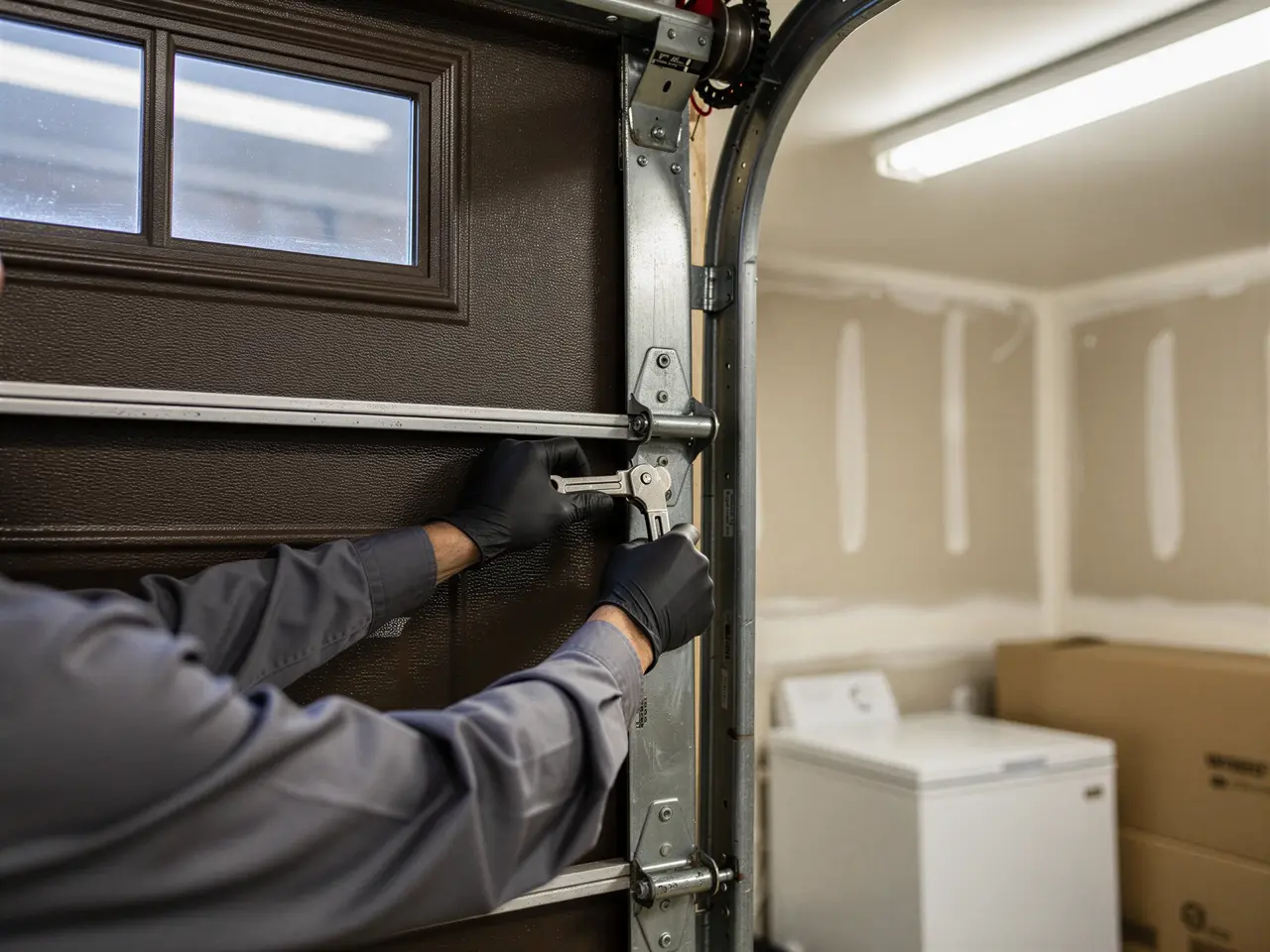
First we find out if the track is bent or just knocked loose from its wall brackets - those are two different repairs and only one of them needs a new part. If the bracket pulled away from the framing, we reset it, check the track for straightness with a level, and re-tension the brackets. If the rail itself has a kink, that section comes out. We don't flex a bent track back into shape and call it fixed; galvanized steel work-hardens where it's been bent, and it will kink again at the same spot. Next we check every roller the door rides on - a roller with a cracked bearing or a worn stem is often what let the door jump the track in the first place, not just the impact that knocked it loose. We check the cables on both sides, since a door that's off-track on one side sometimes has a cable that's partly unspooled from the drum on the other. Once the door is back on true track, we run it up and down by hand before the opener touches it, watching for binding, drag, or a roller that wants to jump again. Only after it tracks clean do we hand it back to the opener.
Why It Happens Here
White Marsh's housing stock runs newer than much of the rest of the Bel Air coverage area - the local median build year here sits around 1985, roughly a decade past the broader-area median of 1977, where most of the stock dates to the 1960s and '70s across the named communities we cover. That later build date matters for this job specifically: a door from 1985 is almost always a steel roller door on a galvanized steel track system, not the older wood-panel door on heavier-gauge track you still find on original hardware elsewhere in the service area. Steel roller doors track well when everything's aligned, but the lighter-gauge rail bends more easily on impact than the older stock does, and it bends in a way that's harder to straighten cleanly. The region sits in a severe cold climate band, and cold steel contracts - brackets that were snug in August can work loose by January, and a door that's been riding slightly off-center all winter is more likely to jump the track the first time it gets bumped or loaded unevenly.
How It Shows Up
The most common sign is a door that binds hard at one specific point in its travel, then runs free the rest of the way - that's usually a roller riding against a track edge instead of inside the channel. Some owners notice a gap of daylight along one side of the door where there shouldn't be one, which means the door itself has shifted off the roller line even if it still closes. A loud bang partway through the cycle, followed by the door stopping dead, often means a roller has already jumped the track and the door is now resting against the rail itself rather than riding in it. On a 1985-era steel roller door, you'll sometimes hear a metallic scrape that isn't present on older wood-panel doors - that's the steel roller catching the edge of a track that's bent just enough to pinch it. If the opener is still trying to run the door while it's off-track, you'll hear the motor strain and may smell it before you see smoke - that's the point to kill power at the wall and stop pulling the cord.
Where This Job Goes Sideways
The job gets harder when the off-track condition isn't isolated - if the door jumped the track because a cable let go first, you now have two failures stacked on top of each other, and fixing the track without checking the cable just sets up a repeat visit. The other complication is spring load: if the door was partway open when it came off the track, the torsion spring may still be holding tension against a door that isn't sitting square, which is not something to force by hand. We've also run into cases where a track section that looks fine is actually bent in a plane you can't see from the floor - slightly bowed outward rather than kinked sideways - and it only shows up once the door is back up and running under its own weight. That's why we test the full cycle before calling a repair done rather than just resetting the door and walking off. On a steel roller door, a track replaced on one side without checking the opposite rail's alignment will fight itself within a few cycles.
The DIY Question
Resetting a roller back into a track by hand is something some owners try, and on a door that's fully down and unloaded, it's not automatically dangerous. The line we draw is the spring. If the door is anywhere but fully closed when it comes off-track, the torsion or extension spring is still under load, and forcing the door back onto the rail while that tension is live is how fingers and faces get hurt. If you can get the door down flat and the opener disconnected, it's reasonable to look at the track and brackets yourself to see if it's a simple bracket reset - snug bolts, straight rail - before calling anyone. What we don't recommend is bending a kinked rail back by hand to save the cost of a new section; it holds for a few cycles and then lets go again, usually with the door moving. If the rail's kinked, or the door was loaded when it jumped, that's a call, not a weekend project.
Frequently asked questions
Why did my garage door jump the track with no warning?
Usually a roller failed first - a cracked bearing or worn stem lets the wheel wobble out of the channel - or a bracket holding the track to the frame worked loose. On steel roller doors common to White Marsh's newer housing stock, cold-weather contraction can also loosen bracket bolts over a winter, so a door that tracked fine in fall can jump the rail by January.
Can I just push the door back onto the track myself?
Only if the door is fully down and the opener is disconnected - then the spring isn't under load and it's reasonably safe to look at. If the door was anywhere else in its travel when it came off, the spring is still carrying tension, and forcing it back onto the rail by hand is how people get hurt. That one's a call.
Do you repair the existing track or replace it?
Depends on what's wrong. A track knocked loose from its wall bracket gets reset and re-tensioned. A track that's actually kinked gets a new section - we don't straighten bent galvanized rail, because it work-hardens at the bend and fails again at the same spot, usually sooner than you'd expect.
How far out do you come for this in White Marsh?
We run out of Bel Air, about 12 miles from White Marsh, and come look at the door in person before quoting anything - an off-track call almost always needs eyes on the track, the rollers, and the cables to know what's actually wrong.
More garage door services in White Marsh
Book garage door service in Bel Air
Call now or request a quote - tell us what the door is doing and where you are.