
Bel Air, MD · Garage Door Service
Garage Door Cable Repair for Bel Air Homes
Snapped or frayed garage door cables are common in Bel Air's 1960s-70s housing stock. Same service area coverage, straight talk on parts and cost factors.
- Repairs & new doors
- Springs & openers
- Serving 7 nearby communities
The Cost of This Job
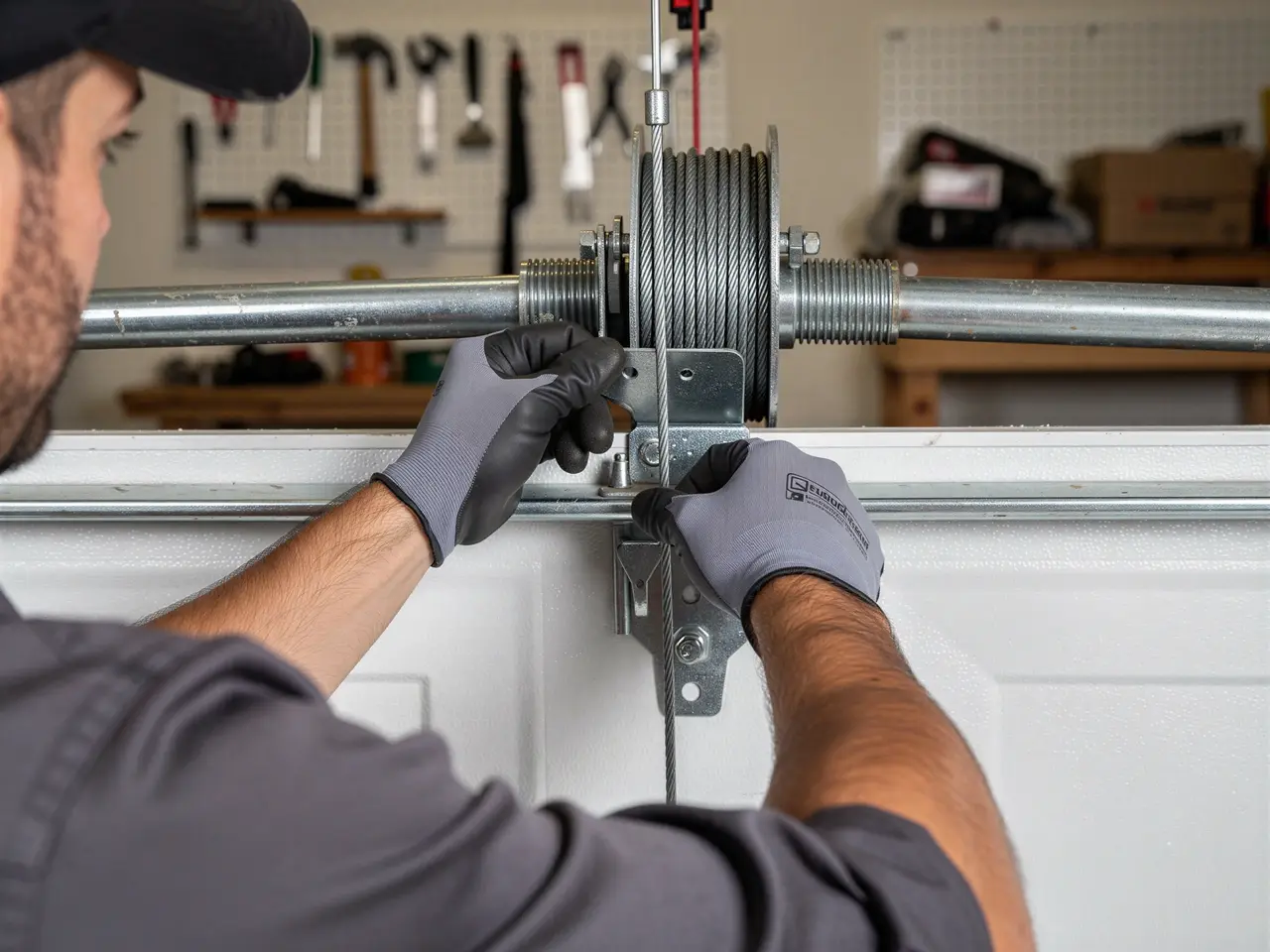
We're not going to throw a number at you that doesn't mean anything until a tech has eyes on your door. Cable repair cost depends on a few things: whether one cable snapped or both, whether the drum or track took damage on the way down, and whether the spring that was sharing the load with that cable is still good or needs to go with it. A single frayed cable caught early, before it jumps the drum and chews up the track, is a different job than a cable that snapped under tension and let the door drop crooked.
What we can tell you is what drives the price up: damage beyond the cable itself. A door that dropped on one side can bend a track, crack a bottom panel, or stress the opener's drive mechanism trying to compensate. That's why we look at the whole door, not just the broken cable, before we quote anything. If the fix really is just the cable, we tell you that and we don't pad the job.
One honest limit: if your door is original to a house built in the 1960s or 70s and the drum, track, and springs are all original too, cable repair alone sometimes isn't the right call. Replacing one worn part on a system where everything else is the same age often means you're back out here in a year for the next piece. We'll tell you straight if that's where your door is.
Parts We Carry
Garage door cables aren't one-size-fits-all, and that matters a lot in a service area where housing spans 1957 to 1990 with a median build year of 1977. Older torsion and extension cable setups used different gauge wire, different drum sizes, and different attachment hardware than what's gone into doors installed in the last fifteen years. We stock common replacement cables sized for both the older hardware still running on original doors from that era and the newer spring and drum assemblies found on doors that have been swapped out since.
We carry galvanized aircraft cable in the gauges that match standard residential torsion and extension systems, plus the drums, end fittings, and safety cables that go with a proper cable job. If your setup uses an odd-ball drum size or a discontinued bracket from an original 1960s or 70s installation, we'll tell you if it's something we need to source rather than have on the truck - that happens more on original hardware than on anything installed recently.
Why It Happens Here
Across the service area, most houses were built between 1957 and 1990, with a lot of that stock concentrated in the 1960s and 70s. Garage door cables have a working life, and on a door that's original or close to it, that life is well past its end. Cable wire fatigues from repeated flexing over the drum, and the zinc coating that protects it from rust wears thin with age and exposure - it doesn't fail all at once, it frays strand by strand until one more cold morning finishes it.
That matters here because the service area sits in a severe cold climate band. Cable steel contracts in hard freezes, and a cable that's already down a few strands from age is more likely to let go on a 10-degree morning than a mild one - the metal has less give left in it right when the temperature swing asks the most of it. A door that's opened and closed daily through decades of that cycle, on hardware nobody's touched since it went in, is exactly the kind of job that brings a cable repair call.
How It Shows Up
The most obvious sign is a door that won't stay level - one side drops faster than the other, or the door hangs crooked in the opening because one cable let go while the other is still holding. Sometimes it's quieter than that: a cable slips off the drum and you hear a grinding or scraping sound right before the door jams partway up or down.
Earlier warning signs are easier to miss. Fraying strands can snag and fling small bits of wire near the bottom bracket, or you'll notice the cable looks loose and wavy instead of pulled taut when the door is down. A door that suddenly feels harder to lift by hand, even with the opener disengaged, can mean a cable is no longer sharing the spring's load the way it should.
If a cable has already snapped, don't try to force the door up or down - a door held by one cable under tension is unstable and can drop without warning. Leave it where it sits and call it in.
Frequently asked questions
Can I replace a garage door cable myself?
We'd advise against it. Cables work under spring tension, and a cable job often means releasing or resetting that tension safely. It's one of the more dangerous DIY garage door repairs - the kind that sends people to the ER for hand and finger injuries. Call it in.
Why did my cable snap with no warning?
It usually wasn't no warning - it was warning you didn't catch. Cables fray strand by strand under normal wear, and on original hardware from an older build, that wear has had decades to add up. A hard freeze can be the final push on a cable that was already most of the way gone.
Does a broken cable mean I need a new door?
Not usually. Most cable failures are a cable, drum, and sometimes a spring - not a full door replacement. We replace the door itself when the frame, track, or panels have taken damage from the drop, or when the hardware is old enough that fixing one part just means the next part fails soon after.
Will my opener fix a dropped door?
No. An opener isn't built to lift or hold a door that's lost a cable - running it can burn out the motor trying to compensate for the lost support. Leave the opener alone, don't force the door by hand either, and call for the cable repair first.
Related services
By Neighborhood
Cable Repair across the Bel Air area
We also handle cable repair in these Bel Air-area suburbs.
Book garage door service in Bel Air
Call now or request a quote - tell us what the door is doing and where you are.