
Bel Air, MD · Garage Door Service
Garage Door Service for Fallston's 1970s Housing Stock
Fallston homes mostly date to the mid-1970s, five miles from our Bel Air shop. We know the original springs, openers, and track from that build era and how to fix them right.
- Repairs & new doors
- Springs & openers
- Serving 7 nearby communities
Why It Happens Here
Fallston's median house was built around 1976, which puts most of the neighborhood squarely in the 1957-1990 window that defines this part of the county. A lot of those garage doors have never had a full hardware swap. The original torsion spring might be thirty, forty, fifty years past its wind-cycle life. The opener could be a second or third unit, but the track and the drums underneath it are often still the ones that came with the house.
That matters because hardware from that era wasn't built for the cold snaps this region gets. Steel contracts in deep cold, and a spring that's already fatigued from decades of cycling is the one that lets go on a 10-degree morning, usually when the door is halfway up. We see it most in houses that have had one owner, or where the garage has never been touched since the original build - the hardware just rode along, unnoticed, until it didn't.
Fallston's household income runs well above the wider service area's median of $95,975, which tells you something different: more of these doors get caught and fixed before they fail outright, because owners here call when something sounds wrong instead of waiting for it to break.
The DIY Question
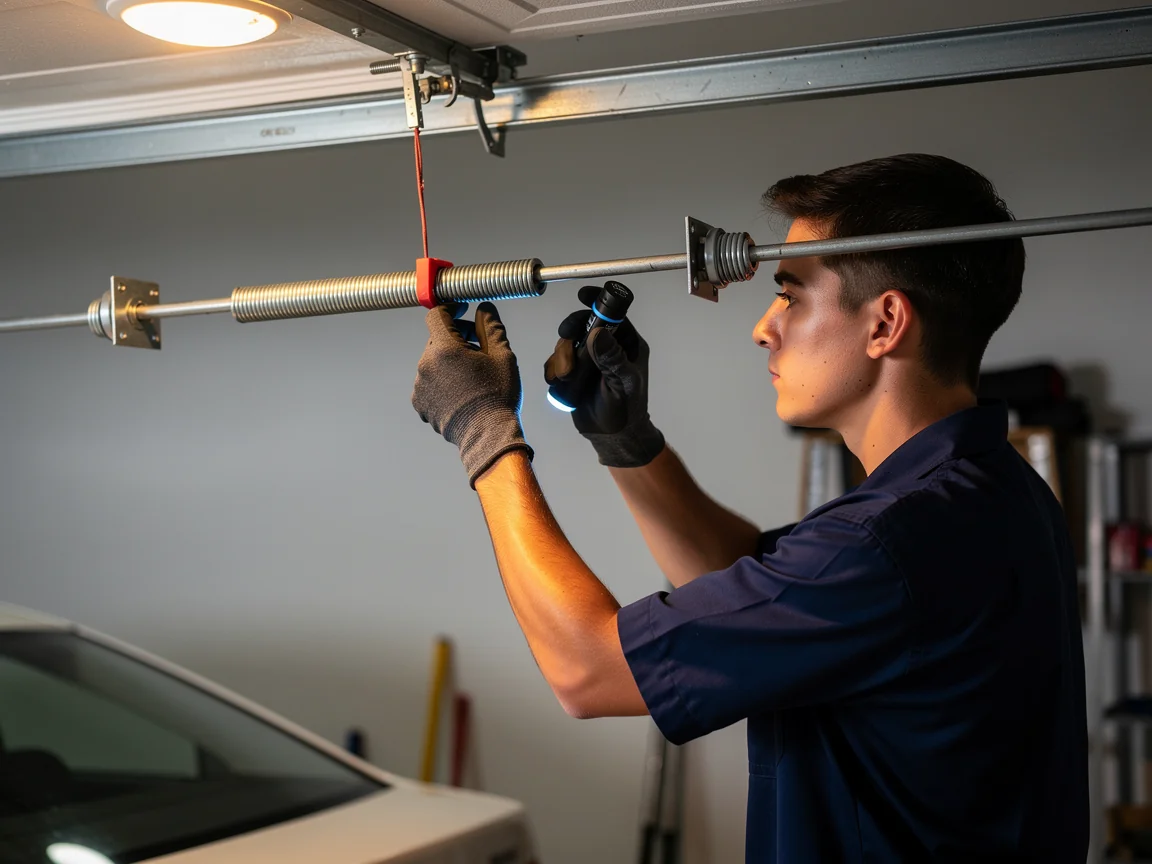
A torsion spring under tension can take a finger or worse, and that's true no matter how handy you are. If the door won't open, or opens a few inches and stops, that's almost always a spring or cable problem, not something to wrench on with the garage door still loaded.
What you can check yourself: the track for dents or gaps where it bolts to the frame, the weatherstripping along the bottom for cracking (common on doors from the 1970s that have never been replaced), and whether the opener's safety sensors are aligned - a blinking light on the opener head usually means one of those two eyes is knocked out of line.
If the door is original to a 1970s-era house and the spring has never been swapped, don't try to re-tension or replace it yourself. That's a one-call job, and it's the one place where DIY and a trip to urgent care overlap more than people expect.
How Long It Takes
A straightforward spring replacement on a standard double door runs under an hour once the truck is on site. Cable repairs and roller swaps are usually similar. Opener replacement takes longer - figure most of a morning or afternoon, depending on whether the existing wiring and header bracket are reusable or need rework.
We're coming from Bel Air, about 5 miles out, so travel isn't the bottleneck - diagnosis and parts are. If a part is a common size, it's usually on the truck already. If the door is old enough that the track or hinge pattern is a discontinued width - which does happen with hardware this age - sourcing that piece can add a day or two. We'll tell you straight when that's the case rather than guess at a timeline.
How We Fix It
We start by checking the age and type of spring - torsion or extension - against what's actually installed, since houses from the mid-1970s sometimes have extension springs that were later swapped for torsion without the rest of the hardware being updated to match. Mismatched systems like that wear unevenly and fail sooner than they should.
For springs, we replace in pairs even if only one has broken, because the other one is the same age and on the same clock. For openers past their useful life, we'll tell you if a repair is worth it or if replacement makes more sense - on a unit that's been cycling since before modern safety-reversal standards, replacement is usually the honest answer, not the upsell.
One limitation worth naming: if a track or drum size turns out to be a size nobody stocks anymore, we may need to order it rather than finish same-visit. We'd rather tell you that up front than promise a same-day fix we can't back up.
How It Shows Up
The most common call from this part of the county is a door that's gone silent and heavy - the spring let go, and now the opener is trying to lift the full weight of the door alone, which can burn out the motor if it runs that way more than a couple of times. Second most common: a door that shudders or jerks partway up, usually a sign the rollers or one cable has started to go on original 1970s-era track that's never been reset or replaced.
With roughly 3,470 households in Fallston and most on that same original-build timeline, these failures cluster in a predictable pattern - not a flood of calls in any one week, but a steady trickle as each house's original hardware hits its own end point. It's less about a single bad storm and more about every house quietly running out the clock on parts installed before most current owners bought the place.
Frequently asked questions
Is my garage door's hardware probably original if my house was built in the 1970s?
Likely at least partly, yes. A lot of Fallston houses from that era have had the opener replaced once or twice, but the spring, track, and drums often never get touched until something breaks. If you've never had a spring swap, treat that hardware as original until proven otherwise.
Do you have a shop in Fallston?
No - we work out of Bel Air and come to Fallston, about 5 miles out. We don't have a branch or depot here, just a truck that covers the area.
Why did my spring snap on a cold morning with no warning?
Steel fatigues with every open-close cycle, and cold makes it more brittle right when it's under the most tension - first lift of the day. A spring that's already near the end of its cycle life often goes on that first cold-morning pull rather than mid-afternoon.
Book garage door service in Bel Air
Call now or request a quote - tell us what the door is doing and where you are.